
|
PLEASE PATRONIZE OUR SPONSORS!





|
|||||||
 |
|
|
Thread Tools | Display Modes |
|
#11
 06-28-2011, 07:48 PM
|
||||
|
||||

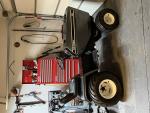
Is it just me or is that pump in the pic missing an auto release valve? It's so dirty it's hard to tell. I'd bite the bullet and buy a new coupler so you can still use a super pump. When all is said and done, that 1872 will be well worth it.
__________________
Adrian 2072 (789513) 
|
|
#12
06-28-2011, 07:53 PM
|
|||
|
|||
|
It has one automatic, and one manual.
|
|
#13
06-28-2011, 07:53 PM
|
||||
|
||||
|
Details of the swap I made are in the '1872' page of my website. Rather than explain it all again in great detail I'll just send you there
 There are lots of pictures and details there that will help you. There are lots of pictures and details there that will help you.The plug is a one-time use only; drill/tap a hole in it and pull it out with a slide hammer. You can get new ones from CC. The swap is much easier if you use the pinion shaft and ring gear from the CI rear. This is what I was intending to do but I couldn't because the ring gear in my CI donor rear was cracked. If you re-use the CI rear pinion shaft and swap ring gears onto the aluminum rear's carrier, all you have to do is take the pinion shaft out, swap the reduction gears, and put it back on. There are shims in there you may have to reconfigure, and you may have to file some casting flash out of the case, as the super reduction gear is thicker than the GT one. As long as you use the original pinion shaft that was in the rear, you don't have to screw with pinion depth adjustments and shims; all you have to do is get the carrier bearing preload correct before attaching the ring gear, and then moving shims from one side to the other until you get the correct contact pattern. If you put in a want ad for shims, you'll likely find some- that's what I had to do when I didn't have enough of a particular size. I know it sounds scary but it's doable. Probably the worst part of the whole job is removing and reinstalling the Eaton retaining ring that holds the pinion shaft in. I think there's special tools for that but my dad and I improvised. If you want, PM me your phone number and a time when you'd be available to talk and I can give you a call and answer any questions you may have.
|
|
#14
06-28-2011, 10:04 PM
|
|||
|
|||
|
Having never gone through a rear end, I understand what the contact pattern should look like, but how do you set the preload on the carrier bearings? How it is measured, and what should it's value be?
It looks like I'll take the path of moving the AL carrier and ring gear into the CI housing and use the super pump. I want to keep this one around, so I might as well do it right, and it's good practice for what I need to do to my 1772.
|
|
#15
06-28-2011, 10:27 PM
|
||||
|
||||
|
The preload is set by adding/removing carrier bearing shims. The process is explained pretty well in any of the service manuals for the IH-built Cub Cadets. The only thing wrong is that the explanation of where to move the shims to get the right contact pattern is bassackwards. The slightly tricky part comes when you get the preload right and then have to move the carrier left or right by moving carrier bearing shims from one side to the other. The good news is it's pretty easy to decide if you've got it right or not by measuring the backlash with a dial indicator and making sure it's on the low end of the spec.
I would highly recommend reading the transaxle disassembly/assembly instructions in both the CCC service manual and an IH service manual. The IH manual is written better but both are useful. Read those and keep asking questions until you know what you have to do.
|
|
#16
06-29-2011, 07:25 PM
|
|||
|
|||
|
I'm gonna give it a go. The manuals were a huge help, as I don't have a dial micrometer, but I see what it's trying to measure. I'll pull apart both of them tonight and see what I have to work with to frankenstein it back together.
|
|
#17
06-30-2011, 05:18 AM
|
|||
|
|||
|
Mike
All you shouls have to do is swap that bull gear, one is thiner than the other and put a new snap ring in. I can preasure wash this rear out of the 147 and bring it over and help you, then Ill know what to do with mine. If this works I can pick up another hydro rear somewhere Im sure. That is if you didnt want to use the fine spline axles. Duke this is the 1872 that Dave had emaild me about.
|
|
#18
06-30-2011, 07:28 AM
|
||||
|
||||
|
If you do the swap, take lots of pictures because I need to do this on my 1772. Dial indicators are pretty cheap. I got mine off of evilpay with a magnetic base and it wasn't much. It's made in China but should be good enough for this type of work. Good luck!
__________________
This ain't no hobby....it's an addiction
|
|
#19
06-30-2011, 08:53 AM
|
|||
|
|||
|
I pulled apart my AL rear and my 'doner' CI rear, and Matt was right, the hardest part was getting that awful snap ring off the pinion. Hopefully it's not too boogered up to reinstall, after I bend it back into shape.
AND those plugs in the front of the rear that cover the pinion gear was a pain, since I don't have a slide hammer to pull it out with. Turns out not many tools can be used to pry in a hole drilled in that plug without bending them. =) So, to move over the ring gear, I should grind off all the rivits on both carriers and bolt the CI ring gear on the AL carrier? Grade 8 allen head screws with locking nuts? What have others used?
|
|
#20
06-30-2011, 10:02 AM
|
||||
|
||||
|
Looks like you are off to a good start. If you have a Harbor Freight nearby you can pick up a cheap dial indicator and magnetic base. They aren't of great quality but will do for this. Oh, and don't bend the snap ring back into shape just yet...do that when you reinstall it. It's not a springy snap ring, it bends, and you're technically only supposed to use it once, but since a new one costs $30 or so, I think twice will be ok as long as it doesn't break when you reinstall it.
A lot of people use button-head allen screws to attach the ring gear to the carrier, but I don't think that's a great idea because no one seems to make those bolts that have an unthreaded portion of the shank, which is what you want to be transferring the load between the ring gear and the carrier. If the threaded portion of the fastener is bearing the load, it'll squash the threads or gall up the holes in the ring gear and carrier, depending on the hardness of the bolts relative to the ring gear and carrier. Now it may be that the bolts provide sufficient clamping force to allow the friction between the ring gear and carrier to transmit the torque, but I did some calculations with some educated guesses for some of the numbers I don't know (I don't know the diameter of the bolt circle for the connection between the ring gear and carrier, or the contact area between the two) and it looks like it could go either way. I'm also assuming that the full torque of the engine can be put to the ground (it can't, or at least not without something else breaking first) so it might be ok but I just don't know. Anyway, where I'm going with all of that is, if I were doing it again (or what I would have done if I had been able to use the CI ring and pinion when I did mine) is use aircraft-grade hex-head bolts, and here is why: 1. They come in many different sizes and grip lengths, so you can get ones that have an unthreaded shank length (grip length) that comes close to the thickness of the ring gear and carrier you are bolting together, so if the bolts don't clamp the ring gear to the carrier tightly enough, the bolts will carry the load without galling the holes in either the ring gear or carrier, and 2. They can be torqued enough to give you some chance of clamping the two pieces together tightly enough so the load is carried by the friction between the ring gear and carrier. So basically, use those, and you'll be safe either way. I hope I didn't lose everybody in that, but I just wanted to explain why I'd do it that way. BTW, the bolts can be obtained here. I can't remember what size the rivets are in there; I think they're 5/16". If that's the case you need the AN5 bolts I linked to. If they are 1/4" you need AN4. You can use those bolts with ordinary fine-thread metal locknuts. The numbering system for those bolts is kinda confusing if you aren't used to it, so if you tell me what the hole diameter actually is, and the combined thickness of the ring gear and carrier where the bolts go, I can tell you exactly which ones you'd need. They are a little bit more expensive than normal hardware-store bolts, but you will absolutely not have any issues with them if you choose to use them. One other thing I should mention is that regardless of which bolts you choose to use, two ways to lock the fastener together is a good idea, i.e. locknut and lockwasher, locknut and loc-tite, etc. so that if one locking method is compromised for some reason the bolt will still hold.
|
|
|
|
Cub Cadet is a premium line of outdoor power equipment, established in 1961 as part of International Harvester. During the 1960s, IH initiated an entirely new line of lawn and garden equipment aimed at the owners rural homes with large yards and private gardens. There were a wide variety of Cub Cadet branded and after-market attachments available; including mowers, blades, snow blowers, front loaders, plows, carts, etc. Cub Cadet advertising at that time harped on their thorough testing by "boys - acknowledged by many as the world's worst destructive force!". Cub Cadets became known for their dependability and rugged construction.
MTD Products, Inc. of Cleveland, Ohio purchased the Cub Cadet brand from International Harvester in 1981. Cub Cadet was held as a wholly owned subsidiary for many years following this acquisition, which allowed them to operate independently. Recently, MTD has taken a more aggressive role and integrated Cub Cadet into its other lines of power equipment.
This website and forum are not affiliated with or sponsored by MTD Products Inc, which owns the CUB CADET trademarks. It is not an official MTD Products Inc, website, and MTD Products Inc, is not responsible for any of its content. The official MTD Products Inc, website can be found at: http://www.mtdproducts.com. The information and opinions expressed on this website are the responsibility of the website's owner and/or it's members, and do not represent the opinions of MTD Products Inc. IH, INTERNATIONAL HARVESTER are registered trademark of CNH America LLC
All material, images, and graphics from this site are the property of www.onlycubcadets.net. Any unauthorized use, reproductions, or duplications are prohibited unless solely expressed in writing.
Cub Cadet, Cub, Cadet, IH, MTD, Parts, Tractors, Tractor, International Harvester, Lawn, Garden, Lawn Mower, Kohler, garden tractor equipment, lawn garden tractors, antique garden tractors, garden tractor, PTO, parts, online, Original, 70, 71, 72, 73, 76, SO76, 80, 81, 86, 100, 102, 104, 105, 106, 107, 108,109, 122, 123, 124, 125, 126, 127, 128, 129, 147, 149, 169, 182, 282, 382, 482, 580, 582, 582 Special, 680, 682, 782, 782D, 784, 800, 805, 882, 982, 984, 986, 1000, 1015, 1100, 1105, 1110, 1200, 1250, 1282, 1450, 1512, 1604, 1605, 1606, 1610, 1615, 1620, 1650, 1710, 1711, 1712, 1806, 1810, 1811, 1812, 1912, 1914.





 Linear Mode

