
|
PLEASE PATRONIZE OUR SPONSORS!





|
|||||||
 |
|
|
Thread Tools | Display Modes |
|
#12
 04-28-2012, 06:37 PM
|
||||
|
||||

Quote:
It is relatively easy (its a lawn mower, not a Kenworth!!)and you will clean and service everything that has been neglected for over 20 years. The weekend spent doing it is well worth it and will pay off bigtime in the future. Plus you will get to know you got a good jump on using the machine for another 20+ years. Cleanliness with these old tractors directly equals dollars, do it!! Oh, yea, take lots of pics, we love pics!! 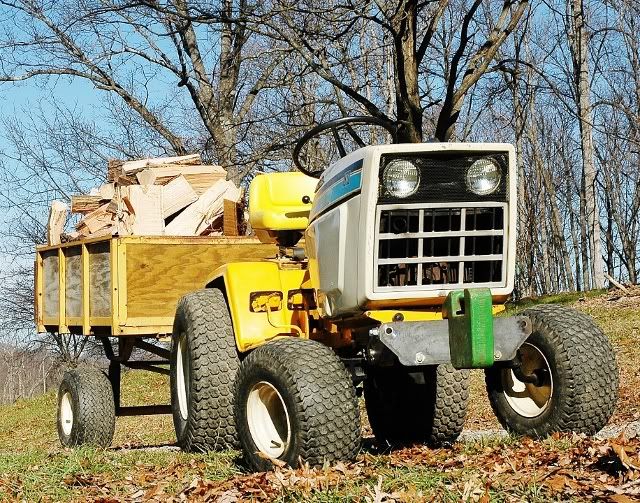

|
|
#13
04-28-2012, 08:59 PM
|
|||
|
|||
|
not sure about sticking valve
you may be a little lean ,try to open your main needle valve 1/4 turn you may have been to lean ,that also makes a popping .
|
|
#14
04-28-2012, 09:02 PM
|
|||
|
|||
|
sticking valve
open your main ,or high speed valve ,if you are to lean it will make apopping sound
|
|
#16
05-02-2012, 09:55 PM
|
||||
|
||||
|
Quote:
__________________
Original OCC Super Mod....and former OCC Co-Admin. I was hacked........
|
|
#18
05-05-2012, 12:29 AM
|
||||
|
||||
|
Dale, The Kohler manuals from 1961 have had MANY revisions to get to the editions that you are quoting from.
In another thread you posted this: Quote:
You also posted this: Quote:
As you know, many folks have had issues with 'old' Kohlers and sticking/stuck exhaust valves, and you even suggested using MMO. If those older engines were already designed to be run on unleaded, there should be no sticking/stuck valve issues! And, there would be no need for an 'upper lube'! From 'Wikipedia' at this address= http://en.wikipedia.org/wiki/Gasoline Tetraethyl leadGasoline, when used in high-compression internal combustion engines, has a tendency to autoignite (detonate) causing damaging "engine knocking" (also called "pinging" or "pinking") noise. Early research into this effect was led by A.H. Gibson and Harry Ricardo in England and Thomas Midgley and Thomas Boyd in the more powerful, higher compression engines. The most popular additive was tetra-ethyl lead. With the discovery of the extent of environmental and health damage caused by the lead, however, and the incompatibility of lead with catalytic converters found on virtually all newly sold US automobiles since 1975, this practice began to wane (encouraged by many governments introducing differential tax rates) in the 1980s. In the US, where lead had been blended with gasoline (primarily to boost octane levels) since the early 1920s, standards to phase out leaded gasoline were first implemented in 1973 — due in great part to studies conducted by Philip J. Landrigan. In 1995, leaded fuel accounted for only 0.6% of total gasoline sales and less than 2000 short tons (1814 t) of lead per year. From 1 January 1996, the Clean Air Act banned the sale of leaded fuel for use in on-road vehicles. Possession and use of leaded gasoline in a regular on-road vehicle now carries a maximum $10,000 fine in the US. However, fuel containing lead may continue to be sold for off-road uses, including aircraft, racing cars, farm equipment, and marine engines.[6] Similar bans in other countries have resulted in lowering levels of lead in people's bloodstreams.[7][8] Yet more info on lead in gasoline, from this address: http://boards.straightdope.com/sdmb/.../t-301632.html In 1987, I was told in my mechanics training that the leaded gas sold had virtually no tetraethyl lead. Leaded gas was completely phased out at the end of that year. If any pump gas in the U.S. has lead in it then it was added in violation of EPA regulations. More likely, the owner just never bothered with replacing the sticker on the pump. Lead was added to gasoline for two reasons, to reduce detonation (http://www.progl.com/General/detonation.htm) (i.e. to increase octane) and to protect the engines' exhaust valves. As the exhaust valves of an engine open and close, they're alternately heated by the exhaust gases that blow past and then pressed against the iron of the heads. The valves in older engines were made of untreated steel and the heads were iron alloy. Without tetraethyl lead, the valves would weld themselves to the head much in the same way that a blacksmith welds steel by heating it in a furnace then hammering it together. Over time this destroys the valves and seating areas. Lead was added to gas to perform a chemical vapor deposition. The lead is vaporized during combustion, is deposited on the valves, and the softer lead creates a barrier layer that keeps the valves and head from bonding together.. Lead in pump gas was phased out for two reasons. First, lead was released into the general environment. Second, besides coating the exhaust valves the lead also coated the pellets in catalytic convertors and (in later models of cars) it coated oxygen sensors, so not only was lead sent out the tailpipe, the emissions controls in a car were destroyed. Other additives have replaced lead as octane enhancers (I think that MTBE has been banned as well.) The exhaust valves and seats are now made out of harder materials. 'ol George was/is correct
__________________
Original OCC Super Mod....and former OCC Co-Admin. I was hacked........
|
|
#19
05-05-2012, 07:42 AM
|
|||
|
|||
|
The manual I quote from is the same manual that is on this site.
http://www.onlycubcadets.net/forum/s...ead.php?t=4646 This is from the same article you quoted from 'Wikipedia' at this address= http://en.wikipedia.org/wiki/Gasoline The first automotive combustion engines, so-called Otto engines, were developed in the last quarter of the 19th century in Germany. The fuel was a relatively volatile hydrocarbon obtained from coal gas. With a boiling point near 85 °C (octanes boil about 40 °C higher), it was well suited for early carburetors (evaporators). The development of a "spray nozzle" carburetors enabled the use of less volatile fuels. Further improvements in engine efficiency were attempted at higher compression ratios, but early attempts were blocked by knocking (premature explosion of fuel). In the 1920s, antiknock compounds were introduced by Migley and Boyd, specifically tetraethyl lead (TEL). This innovation started a cycle of improvements in fuel efficiency that coincided with the large-scale development of oil refining to provide more products in the boiling range of gasolines. In the 1950s oil refineries started to focus on high octane fuels, and then detergents were added to gasoline to clean the jets and carburetors. The 1970s witnessed greater attention to the environmental consequences of burning gasoline. These considerations led to the phasing out of TEL and its replacement by other antiknock compounds. Subsequently, low-sulfur gasoline was introduced, in part to preserve the catalysts in modern exhaust systems.[3] Leaded gas was introduce in 1920s. The so called uncreated fuel was around before the 1920s. Model Ts were runned on ethanol until 1908 according to this article: http://en.wikipedia.org/wiki/Ethanol#History Sticking valve issues can be cause poor maintance. Good examples are bad rings and engine running on the rich side. The "hammering" you are talking about in the the angle part of the valve hitting the valve seat. Lead acts as a cushion when the valve hit the seat...not a lubricant. It's your choice to believe Old Goerge is correct.....show some prof.
|
|
#20
05-05-2012, 12:01 PM
|
||||
|
||||
|
True, the lead was introduced into the gas in the '20s
In the 1920s, antiknock compounds were introduced by Migley and Boyd, specifically tetraethyl lead (TEL). This innovation started a cycle of improvements in fuel efficiency that coincided with the large-scale development of oil refining to provide more products in the boiling range of gasolines. I still doubt that Kohler engineers in the late 1950s/early 1960s were designing engines to burn fuel that had not been available, (or at a VERY minimum, widely used) for 30+ years. Did they have a crystal ball or something? How would they know that 10 to 15 years after they would design an engine for OPE usage, that the US Government would decide to start phasing out the fuel that was common for it's day, and mandate a fuel with a different chemical composition............ The lead was introduced for a reason, and that same reason is why other products are still introduced into the gasoline we use today, not to mention all of the other multitude of chemicals added to appease the feds. Will the old Kohlers run on unleaded...apparently so. As does a whole bunch of other equipment-trucks-tractors-L&G equipment, etc, etc, that were designed and built long before 1973. PLUS just because the unleaded was being phased in beginning in 1973, does not mean that it was an instant 'flip' to it's use. The transition went into the 1980s. So to say that these old engines were puposely designed to burn a fuel that was not in use at the time, is asinine.
__________________
Original OCC Super Mod....and former OCC Co-Admin. I was hacked........
|
|
|
|
Cub Cadet is a premium line of outdoor power equipment, established in 1961 as part of International Harvester. During the 1960s, IH initiated an entirely new line of lawn and garden equipment aimed at the owners rural homes with large yards and private gardens. There were a wide variety of Cub Cadet branded and after-market attachments available; including mowers, blades, snow blowers, front loaders, plows, carts, etc. Cub Cadet advertising at that time harped on their thorough testing by "boys - acknowledged by many as the world's worst destructive force!". Cub Cadets became known for their dependability and rugged construction.
MTD Products, Inc. of Cleveland, Ohio purchased the Cub Cadet brand from International Harvester in 1981. Cub Cadet was held as a wholly owned subsidiary for many years following this acquisition, which allowed them to operate independently. Recently, MTD has taken a more aggressive role and integrated Cub Cadet into its other lines of power equipment.
This website and forum are not affiliated with or sponsored by MTD Products Inc, which owns the CUB CADET trademarks. It is not an official MTD Products Inc, website, and MTD Products Inc, is not responsible for any of its content. The official MTD Products Inc, website can be found at: http://www.mtdproducts.com. The information and opinions expressed on this website are the responsibility of the website's owner and/or it's members, and do not represent the opinions of MTD Products Inc. IH, INTERNATIONAL HARVESTER are registered trademark of CNH America LLC
All material, images, and graphics from this site are the property of www.onlycubcadets.net. Any unauthorized use, reproductions, or duplications are prohibited unless solely expressed in writing.
Cub Cadet, Cub, Cadet, IH, MTD, Parts, Tractors, Tractor, International Harvester, Lawn, Garden, Lawn Mower, Kohler, garden tractor equipment, lawn garden tractors, antique garden tractors, garden tractor, PTO, parts, online, Original, 70, 71, 72, 73, 76, SO76, 80, 81, 86, 100, 102, 104, 105, 106, 107, 108,109, 122, 123, 124, 125, 126, 127, 128, 129, 147, 149, 169, 182, 282, 382, 482, 580, 582, 582 Special, 680, 682, 782, 782D, 784, 800, 805, 882, 982, 984, 986, 1000, 1015, 1100, 1105, 1110, 1200, 1250, 1282, 1450, 1512, 1604, 1605, 1606, 1610, 1615, 1620, 1650, 1710, 1711, 1712, 1806, 1810, 1811, 1812, 1912, 1914.


 Linear Mode

